
Technical Data of the San Patrick
History, specifications and the structural problem of the T2 Tankers
Vessel History
A wartime tanker converted into a freighter
Names and Owners
Original Specifications (1944)
| Type | T2-SE-A1 Tanker |
|---|---|
| Shipyard | Alabama Drydock & Shipbuilding Co. |
| Build time | 77 days |
| Length | 169.5 m (523 ft 6 in) |
| Beam | 20.7 m (68 ft) |
| Draft | 9.1 m (30 ft) |
| Gross tonnage | 10,448 GRT |
| Deadweight | 16,613 DWT |
| Propulsion | Turbo-electric, 6,000 SHP |
| Speed | 14.5 - 15 knots |
Conversion to Bulk Carrier (1964)
| Conversion shipyard | Yokohama, Japan |
|---|---|
| New length | 169.5 m |
| New tonnage | 14,494 - 14,500 tons |
| Increase | +5,000 tons approx. |
Conversion process:
The vessel was cut in two and a new central section was inserted to increase cargo capacity. The bridge was relocated. This practice was common in the 1960s to extend the service life of T2 tankers.
The San Patrick’s voyage to Yokohama was, in fact, her first after the conversion.
The T2-SE-A1 Series
The workhorse of the Allied tanker fleet
Mass Production
Between 1942 and 1945, the United States built 481 T2 tankers at four shipyards:
- Alabama Drydock & Shipbuilding Co. — Mobile, Alabama
- Kaiser Company Swan Island Yard — Portland, Oregon
- Marinship Corporation — Sausalito, California
- Sun Shipbuilding & Drydock Co. — Chester, Pennsylvania
The construction record is held by the Huntington Hills, completed in just 33 days.
Notable Sister Ships
| Schenectady | Broke in two at the dock (1943) |
|---|---|
| Esso Manhattan | Hull fracture leaving New York (1943) |
| Pendleton | Broke in two, 1952 — subject of the film The Finest Hours |
| Fort Mercer | Broke in two on the same day as the Pendleton |
| Marine Electric | Sunk in 1983 — led to safety reforms |
The Fracture Problem
A structural defect that cost lives and ships
Construction Defects
The accelerated wartime construction, combined with all-welded hulls (without rivets) and low-grade steels, caused many T2 tankers to suffer catastrophic fractures, especially in cold waters.
Photographic Evidence
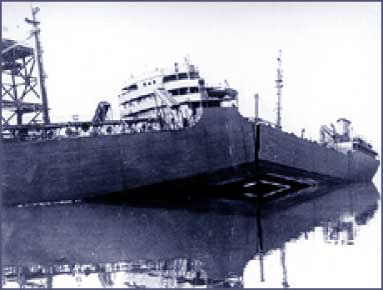
Fracture in dry dock
T2 Tanker with a visible fracture in the hull. The steel would fail without warning due to the phenomenon of cold-temperature embrittlement.
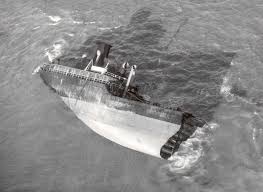
Fracture at sea
T2 vessel broken in two at sea. Fractures could propagate across the entire hull within seconds.
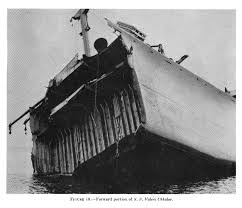
S.S. Valchem — severed bow
Bow section of the S.S. Valchem after breaking apart. Defective welds acted as starting points for the fractures.
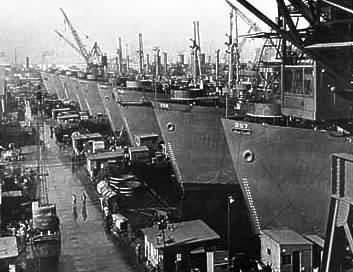
Mass production
U.S. shipyard building vessels in series. Production speed took precedence over quality control.
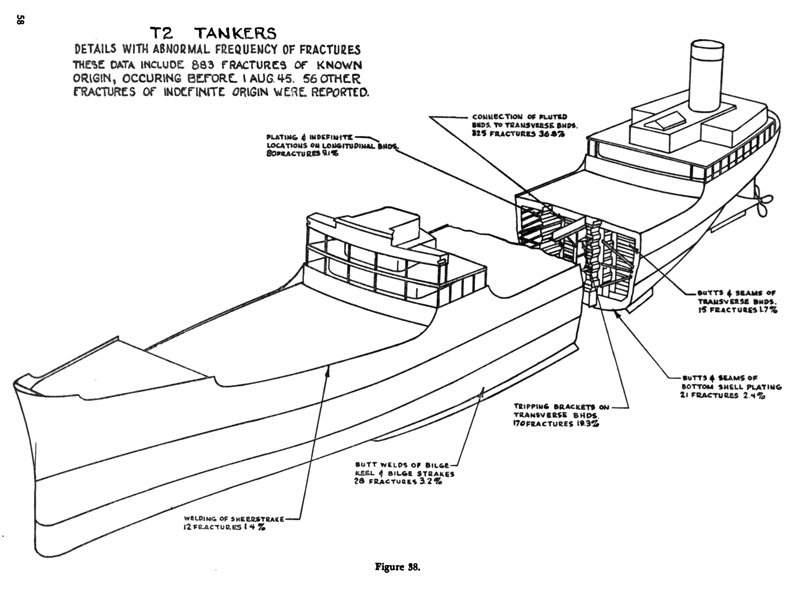
Official diagram: fracture zones in T2 Tankers
1947 report: 883 fractures documented before August 1945. The most affected areas were the connections of transverse bulkheads (36.8%), bulkhead supports (19.3%) and keel welds (3.2%). The San Patrick, as a T2-SE-A1, was susceptible to these same structural failures.
Identified Causes
- All-welded construction: No rivets to halt crack propagation
- Low-grade steel: Became brittle at low temperatures
- Notched design: Square corners that concentrated stress
- Accelerated construction: Insufficient quality control
- Residual stresses: From defective welds
Relevance to the San Patrick
- She was a T2-SE-A1 built in 77 days in 1944
- She had 20 years of service when she was wrecked
- She had undergone a major structural conversion
- She was sailing in extremely cold waters (the Aleutians)
- The exact causes of the wreck remain undetermined
- A structural failure cannot be ruled out
Solutions Implemented (1947)
Following the report of the U.S. investigative commission, all T2 tankers in service were ordered to be reinforced:
- Riveted steel straps: Two bands 191 ft long and 12.5 in wide, on both sides of the hull (tanks 3 to 8)
- Deck straps: Two 15-in wide bands riveted on both port and starboard
- Function: Acting as “barrel hoops” to halt crack propagation
It has not been possible to confirm whether the San Patrick carried these reinforcements after her 1964 conversion.
Sources and References
- Ship Structure Committee Report SSC-244: “Fracture Control Guidelines for Welded Ship Hulls”
- “T2 Tankers” — Ships Monthly, April 2002
- U.S. Maritime Commission — Outboard Profiles of Maritime Commission Designed Vessels
- T2 Tankers Fracture Report (1947)
- U.S. Coast Guard documentation